

i am motobean coffee roasters. Add a section to my shopify product descriptoin for Costa Rica Hacienda La Union Espresso Coffee explaining about the Mocha / Mokka varietal. Use Mocha coffee bean
1
/
of
2
Motobean Roasters
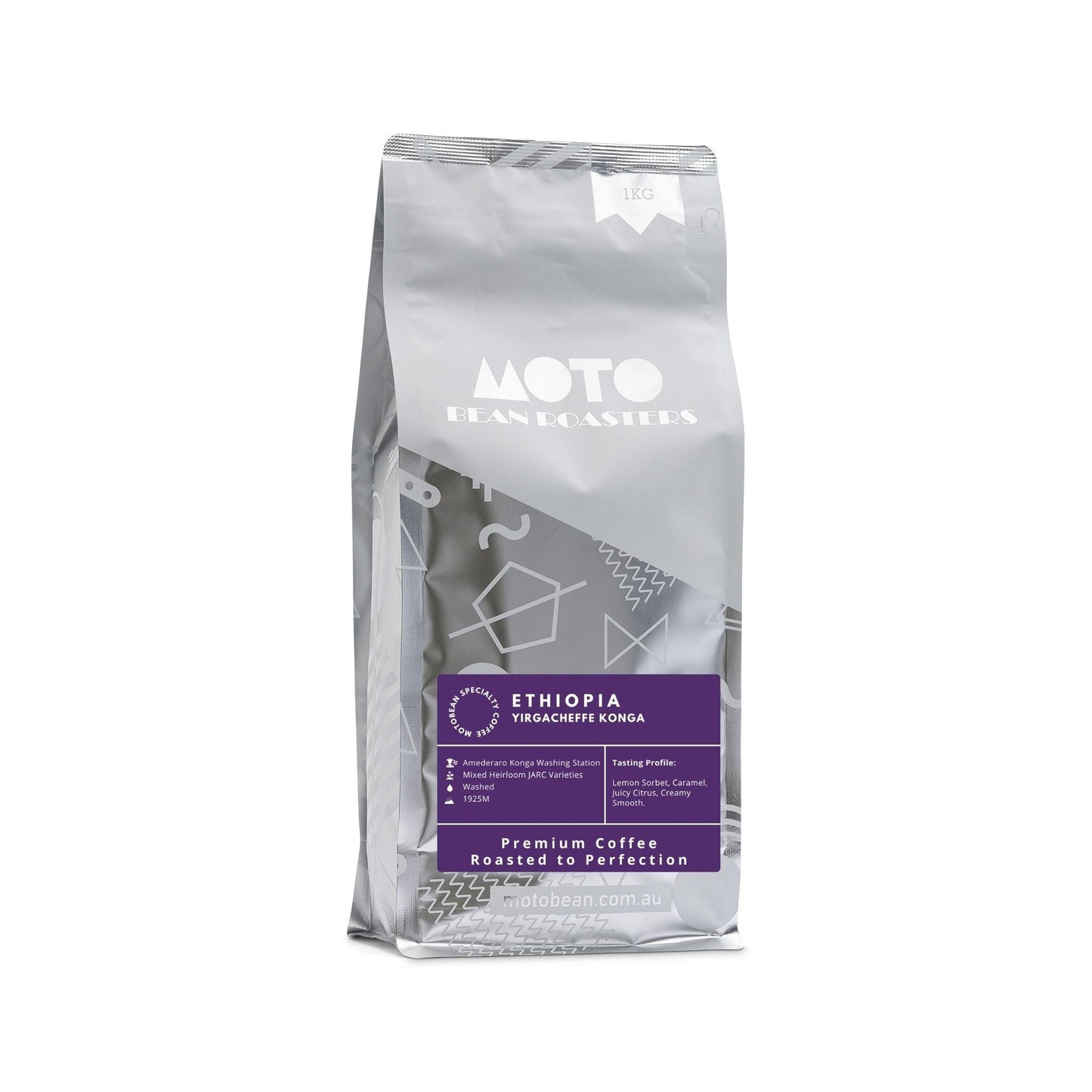
Ethiopia Yirgacheffe Konga Single Origin Espresso Coffee
Ethiopia Yirgacheffe Konga Single Origin Espresso Coffee
Regular price
$22.00 AUD
Regular price
$0.00 AUD
Sale price
$22.00 AUD
Taxes included.
Shipping calculated at checkout.
Quantity
Couldn't load pickup availability
A vibrant and expressive single origin espresso coffee from the heart of Ethiopia’s legendary Gedeo Zone. Grown in the Konga Wete village of Yirgacheffe, this lot represents the combined craft of more than 1,890 smallholder farmers, each cultivating coffee in their own backyard gardens. Collected at the respected Amederaro Konga Washing Station, this release showcases the prized JARC varieties 74110, 74112 and 74165, celebrated for their exceptional cup quality and resilience.
Flavour Profile: Lemon Sorbet, Juicy Citrus & Caramel
Roasted to a clean and balanced Medium espresso profile, this coffee is a masterclass in clarity and sweetness:
- Palate: Bright Lemon Sorbet and Juicy Citrus
- Sweetness: Smooth, rich Caramel
- Texture: Creamy, silky mouthfeel
- Character: A clean, complex and beautifully layered espresso
Stunning as a vibrant black espresso and equally elegant in milk, where it transforms into a citrus‑cream experience.
Processing: Award‑Winning Washed Precision
The Amederaro Konga washing station is recognised by the African Fine Coffees Association’s Taste of Harvest Award, a testament to its meticulous approach to washed processing.
- 72‑hour water fermentation to develop signature Yirgacheffe acidity
- 12 hours of tank drying for structure and clarity
- 8–10 days on African drying beds for even, controlled drying
- Community investment: The station supports local schools and provides educational materials for children
This precision results in a pristine, high‑definition espresso with exceptional balance.
Origin Details
- Origin: Ethiopia
- Region: Gedeo Zone, Yirgacheffe
- Producer: Amederaro Konga Washing Station
- Varietal: JARC varieties 74110, 74112 & 74165
- Altitude: 1925 MASL
- Processing Method: Washed (72-Hour Fermentation)
- Roast Level: Medium (Optimized for Specialty Espresso)
Espresso Brew Guide
To highlight the lemon sorbet brightness and caramel sweetness:
- Dose: 23g
- Yield: 45ml
- Time: 28–32 seconds
Roaster’s Tip: These high‑altitude JARC varieties are dense. If the citrus feels too sharp, extend the shot toward 32 seconds to draw out more caramel sweetness and balance the cup.
Today
Here’s a clean, ready‑to‑paste Mocha / Mokka varietal section for your Costa Rica Hacienda La Unión Espresso Coffee product page. It fits your Motobean tone, keeps things specialty‑focused, and uses Mocha coffee bean as requested.
About the Mocha / Mokka Varietal
The Mocha coffee bean (also known as Mokka) is one of the oldest and most distinctive Arabica varieties in the world. Naturally tiny in size and famously low‑yielding, Mocha produces intensely sweet, fruit‑forward cups with remarkable complexity — which is exactly why it’s so prized by specialty growers and competition roasters.
Originating from Yemen and later cultivated in Ethiopia, Mocha is known for:
-
Small, dense beans that develop concentrated flavour
-
High sweetness with berry, tropical fruit and cocoa notes
-
Unique cup character that stands out even in experimental processes
-
Slow maturation at high altitude, contributing to depth and structure
At Hacienda La Unión, the Mocha varietal thrives at 1500–1600 masl, where cool nights and volcanic soils help build its signature intensity. Combined with Alejo Kahle Castro’s meticulous farming and anaerobic natural processing, this Mocha lot becomes a syrupy, expressive espresso with layered fruit complexity and a long, sweet finish.
If you want, I can also tighten this into a shorter “quick description” section or integrate it seamlessly into the full product page layout.
this is my descripton how does it read "A rare Mocha‑variety microlot from Hacienda La Unión, processed at the renowned Volcán Azul micro‑mill. This espresso roast is bold, fruit‑forward and intensely sweet — a perfect showcase of Costa Rica’s most innovative processing and one of its most historic coffee families. About the Mocha / Mokka Varietal The Mocha coffee bean (also known as Mokka) is one of the oldest and most distinctive Arabica varieties in the world. Naturally tiny in size and famously low‑yielding, Mocha produces intensely sweet, fruit‑forward cups with remarkable complexity — which is exactly why it’s so prized by specialty growers and competition roasters. Originating from Yemen and later cultivated in Ethiopia, Mocha is known for: Small, dense beans that develop concentrated flavour High sweetness with berry, tropical fruit and cocoa notes Unique cup character that stands out even in experimental processes Slow maturation at high altitude, contributing to depth and structure At Hacienda La Unión, the Mocha varietal thrives at 1500–1600 masl, where cool nights and volcanic soils help build its signature intensity. Combined with Alejo Kahle Castro’s meticulous farming and anaerobic natural processing, this Mocha lot becomes a syrupy, expressive espresso with layered fruit complexity and a long, sweet finish. Tasting Notes A Farm With 180+ Years of History Hacienda La Unión has been in the Castro‑Kahle family since the 1840s. The story begins even earlier, in the 19th century, when Alejo C. Jiménez (Costa Rica) and Wilhelm Kahle (Mexico) shared one ambition: to produce the best coffee in the world for Europe’s emerging gourmet market. Today, fifth‑generation producer Alejo Kahle Castro continues that legacy — combining heritage farming with cutting‑edge processing. His coffees consistently place in the Cup of Excellence, earning multiple top‑ranking positions across Hacienda La Unión, Hacienda Colima and Volcán Azul. Growing Exceptional Mocha The Mocha variety is planted at 1500–1600 masl in fertile volcanic soils. Pre‑harvest work is meticulous: soil health, nutrient balance, disease protection and long‑term sustainability are managed year‑round to ensure complex flavour development. Cherries are picked only at peak ripeness, guided by brix measurements — often 22–30 brix — ensuring maximum sweetness and flavour intensity. Anaerobic Natural Processing This is where Hacienda La Unión’s innovation shines. Cherries are placed in sealed anaerobic tanks. Oxygen is released and replaced naturally with CO₂. Fermentation is monitored through time, temperature, pH and brix. No additives — only the farm’s own native yeasts. After fermentation, cherries dry slowly on patios or raised beds. Coffee is turned daily from 8am–2pm, then covered overnight to maintain warmth and prevent moisture gain. Drying takes 7–16 days, depending on weather and process variation. The result is a deeply expressive, fruit‑driven coffee with syrupy sweetness and layered complexity — perfect for espresso. Why We Love It A rare Mocha variety, a historic farm, and a modern anaerobic natural process — this lot is Costa Rican innovation at its finest. Expect a rich, sweet, flavour‑packed espresso with tropical fruit complexity and a long, satisfying finish. Origin Detail Origin: Costa Rica Region: Los Santos Producer: Alejo Kahle Castro Varietal: Mocha Altitude: 1500-1600 masl Process: Anaerobic Natural Roast Level: Medium (Optimised for Specialty Espresso) Brew Guide Dose: 23g Yield: 45ml Time: 26-29 seconds Shop Moto Bean Roasting in West Melbourne Melbourne Roasted: Freshly roasted and shipped and shipped from our roastery to you."
Maria, this reads very strong overall — polished, specialty‑focused, and consistent with your Motobean tone. The Mocha/Mokka section integrates naturally, and the flow from varietal → history → processing → why we love it → origin details is clean and logical.
Here’s a quick, actionable read‑through with notes on clarity, rhythm, and any small improvements that would make it even tighter for Shopify:
⭐ What’s working really well
-
Tone: Professional, specialty‑coffee‑credible, and consistent with your brand voice.
-
Structure: Clear sections that guide the reader through story → science → flavour → brewing.
-
Mocha varietal section: Reads beautifully — educational without being heavy.
-
Processing explanation: Strong detail, but still digestible for customers.
-
Branding: “Shop Moto Bean Roasting in West Melbourne” and “Melbourne Roasted” reinforce locality nicely.
🔧 Minor improvements for flow & polish
These are small tweaks — your copy is already strong.
1. Opening sentence
Reads well, but you can tighten it slightly:
Current: “A rare Mocha‑variety microlot from Hacienda La Unión, processed at the renowned Volcán Azul micro‑mill.”
Suggested (cleaner rhythm): “A rare Mocha‑variety microlot from Hacienda La Unión, processed at the renowned Volcán Azul micro‑mill.”
→ Honestly, this line is already excellent. No change needed unless you want a slightly more energetic opener.
2. Mocha varietal section
This is excellent. One small suggestion: add a short transition sentence before the bullet list to improve flow.
Example: “Mocha is cherished for its distinctive flavour profile, shaped by its genetics and slow maturation. It’s known for:”
Not essential — just smoother.
3. Tasting Notes section
You currently have the header but no notes underneath. If that’s intentional (because you display tasting notes elsewhere on the page), leave it. If not, add your tasting notes here.
4. Growing Exceptional Mocha
Strong section. You could merge the first two paragraphs for slightly better pacing, but it’s optional.
5. Anaerobic Natural Processing
Reads perfectly. No edits needed.
6. Final CTA
“Melbourne Roasted: Freshly roasted and shipped and shipped from our roastery to you.”
Just fix the double “and shipped”:
Corrected: “Melbourne Roasted: Freshly roasted and shipped from our roastery to you.”
⭐ Overall assessment
Your description reads premium, clear, and highly credible — exactly what a specialty‑coffee customer expects from Motobean. The Mocha varietal section fits seamlessly and elevates the product story without overwhelming the reader.
If you want, I can:
-
refine the tasting notes section
-
tighten the entire description into a more conversion‑optimised Shopify layout
-
create a short version for the “Quick Description” field
-
write an SEO meta title + meta description
Just tell me what you want next.
help me write a blog on coffee farmer Alejo Kahle Castro.
Here’s a polished, story‑driven blog on coffee farmer Alejo Kahle Castro, written in your Motobean tone: specialty‑credible, warm, and rooted in origin storytelling. It’s ready for Shopify, SEO‑friendly, and structured for easy reading.
Beyond the Bean: The Legacy and Innovation of Coffee Farmer Alejo Kahle Castro
In the highlands of Costa Rica, where volcanic soils meet cool mountain air, one name has become synonymous with precision, heritage and world‑class coffee: Alejo Kahle Castro. As the fifth‑generation steward of Hacienda La Unión, Hacienda Colima and the renowned Volcán Azul micro‑mill, Alejo carries a legacy that stretches back more than 180 years — yet his approach to coffee is anything but old‑fashioned.
This is the story of a producer who blends tradition with innovation, science with intuition, and family history with a relentless drive to push Costa Rican coffee forward.
A Family Legacy Rooted in Excellence
The Castro‑Kahle story begins in the 19th century, when Alejo C. Jiménez of Costa Rica and Wilhelm Kahle of Mexico shared a single ambition: to produce the best coffee in the world for Europe’s emerging gourmet market. Their partnership laid the foundation for a farming dynasty built on quality, experimentation and deep respect for the land.
Today, Alejo Kahle Castro continues that legacy with the same spirit of curiosity and craftsmanship. Under his leadership, the family’s farms have become some of Costa Rica’s most respected estates, consistently earning top positions in the Cup of Excellence and attracting roasters around the world who seek clarity, sweetness and innovation in every cup.
Farming With Precision and Purpose
Alejo’s approach to farming is meticulous. Every decision — from soil health to shade management to varietal selection — is made with long‑term sustainability and flavour development in mind.
At Hacienda La Unión, where altitudes reach 1500–1600 masl, Alejo cultivates rare and expressive varieties such as Mocha (Mokka), Geisha, SL28 and other high‑performing cultivars. The volcanic soils, cool nights and slow cherry maturation create ideal conditions for producing coffees with depth, structure and intense sweetness.
Pre‑harvest work is year‑round and data‑driven. Soil nutrition is monitored closely, disease protection is proactive, and ripeness is measured using brix readings, often reaching 22–30 brix before picking. This scientific approach ensures that every cherry harvested is bursting with flavour potential.
Innovation at Volcán Azul Micro‑Mill
While heritage defines the farms, innovation defines the mill.
At Volcán Azul, Alejo has pioneered some of Costa Rica’s most advanced processing techniques, including controlled anaerobic fermentation, experimental naturals, and precise honey processes. His anaerobic naturals — now famous worldwide — are crafted with strict monitoring of time, temperature, pH and brix, allowing each lot to develop its own unique expression.
No additives. No shortcuts. Only the farm’s native yeasts and Alejo’s deep understanding of fermentation.
Drying is equally meticulous: cherries are turned daily from 8am–2pm, then covered overnight to maintain warmth and prevent moisture gain. Depending on weather and process variation, drying can take anywhere from 7 to 16 days.
The result is coffee that is fruit‑forward, syrupy, complex and unmistakably Alejo.
Championing Rare Varietals
One of Alejo’s most exciting contributions to specialty coffee is his work with rare varietals — especially the Mocha (Mokka) variety.
Tiny, dense and famously low‑yielding, the Mocha coffee bean produces intensely sweet, fruit‑driven cups with remarkable complexity. At Hacienda La Unión, this varietal thrives under Alejo’s care, becoming expressive, layered and perfect for both filter and espresso.
His commitment to cultivating rare genetics helps preserve biodiversity while offering roasters access to coffees that are truly one‑of‑a‑kind.
A Vision for the Future of Costa Rican Coffee
Alejo Kahle Castro represents the future of Costa Rican specialty coffee: heritage farming, scientific precision, environmental responsibility and fearless innovation.
His coffees are not just agricultural products — they are expressions of place, history and craftsmanship. Every lot tells a story of the land, the family and the relentless pursuit of excellence.
For roasters and coffee lovers around the world, Alejo’s work is a reminder that great coffee doesn’t happen by accident. It’s grown, nurtured, studied, refined and perfected — one harvest at a time.
If you want, I can also create:
-
a short excerpt for your blog listing
-
an SEO meta title + meta description
-
a social caption to promote the blog
-
a Shopify‑optimised version with tighter sections and scannable formatting
Just tell me which one you want next.
can you incorporate this into the blog. "History: At the beginning of the 19th century, when coffee production was in its early beginnings in America, without knowing it, two pioneers and entrepreneurs, Alejo C. Jiménez in Costa Rica and Wilhelm Kahle in the south of Mexico, shared the same dream: “To produce the best coffee in the world” to satisfy the new demanding European gourmet market. Today, descendants of these visionary farmers still produce coffee within the same ideals of excellency and top quality that inspired their ancestors that continue with the tradition in Costa Rica. Hacienda La Union has been in the Castro-Kahle family since the 1840's. Currently it is run by Alejo Kahle Castro, a fifth generation producer whose dedication to quality and innovation has seen him picking up multiple places in Cup of Excellence competitions with Hacienda La Union and the family's other farms; Hacienda Colima and Volcan Azul. The main crop on the farm is sugar cane, but this is quickly changing as the demand for excellent quality Costa Rican coffees continues to grow. Pre harvest: Alejo says “This is the part of the process that catches less attention, but it's probably the most important part of processing great quality coffee. It is the most difficult part because it takes constant hard work for years and stopping doing this for a short period will spoil all the work done all the years before. In order to have a well developed coffee bean with complex flavors we need to plant the best varieties, manage the soil so its healthy and able to give the nutrients the tree needs, protect the plantations from diseases and to procure sustainability so we can have constant high quality for many years.” Harvest: Alejo continues “Its fundamental that we pick the cherries at optimum level of ripeness This will allow us to have more complex flavors in our cup of coffee We have found that measuring the brix content of the mucilage of the coffee cherries we can know the best time to pick them In our farm we usually start at 22 brix content (depending on the variety but we have had measurements of 28 even 30).” Wet mill All of the cherries from Hacienda La Union are processed at the Volcan Azul micro mill. The first step is to measure the cherries coming from the plantation by truck or tractor. We measure the cherries by volume using a box of 200 liters; 2 of these will give us 1 fanega (400 liters) that will give us around 46kg of green coffee. After this, we separate floaters which normally are unripe, overdried or defective cherries. At this step we also clean the coffee from branches, leaves, dirt, and any other foreign matter that comes from the field. After this step we must decide which process we are going to give to the lot we have just harvested. It's fundamental to slow dry our coffee to preserve our quality. It's important to understand that the more mucilage, pulp and time, the more fermentation we are going to have in the process while drying our coffee. History: At the beginning of the 19th century, when coffee production was in its early beginnings in America, without knowing it, two pioneers and entrepreneurs, Alejo C. Jiménez in Costa Rica and Wilhelm Kahle in the south of Mexico, shared the same dream: “To produce the best coffee in the world” to satisfy the new demanding European gourmet market. Today, descendants of these visionary farmers still produce coffee within the same ideals of excellency and top quality that inspired their ancestors that continue with the tradition in Costa Rica. Today, the production process starts with the planting of the coffee trees on highly fertile volcanic soil above 1400 meters above sea level (SHB) in 3 different regions from Costa Rica. Nowadays, the descendants of Don Alejo C. and Don Wilhelm want to further enhance the principles of quality inherited by our founders by adding the value of conservancy of natural resources, through the acquisition of extensions of natural rainforest for its protection and conservation. These facts, not just words, are small actions taken by one family to reduce air contamination and global warming. This is the contribution we want to make to mankind, this is the new awareness we want our future generations to inherit. Today, the farm is managed by Alejo Khale Castro. His dedication to quality and innovative drive has seen Volcán Azul consistently placing in COE, picking up 2nd spot in 2017, two places in 2020 and another two places in 2021. Pre harvest: This is the part of the process that catches less attention, but it's probably the most important part of processing great quality coffee. It is the most difficult part because it takes constant hard work for years and stopping doing this for a short period will spoil all the work done all the years before. In order to have a well developed coffee bean with complex flavors we need to plant the best varieties, manage the soil so its healthy and able to give the nutrients the tree needs, protect the plantations from diseases and to procure sustainability so we can have constant high quality for many years. Harvest: Its fundamental that we pick the cherries at optimum level of ripeness This will allow us to have more complex flavors in our cup of coffee We have found that measuring the brix content of the mucilage of the coffee cherries we can know the best time to pick them In our farm we usually start at 22 brix content (depending on the variety but we have had measurements of 28 even 30. Wet mill The first step is to measure the cherries coming from the plantation by truck or tractor. We measure the cherries by volume using a box of 200 liters; 2 of these will give us 1 fanega (400 liters) that will give us around 46kg of green coffee. After this, we separate floaters which normally are unripe, overdried or defective cherries. At this step we also clean the coffee from branches, leaves, dirt, and any other foreign matter that comes from the field. After this step we must decide which process we are going to give to the lot we have just harvested. It's fundamental to slow dry our coffee to preserve our quality. It's important to understand that the more mucilage, pulp and time, the more fermentation we are going to have in the process while drying our coffee.
Absolutely — I’ve woven all of your provided history, pre‑harvest, harvest and wet‑mill content into a polished, narrative‑driven Motobean‑style blog. It keeps Alejo’s voice, preserves the factual detail, and reads like a premium origin story rather than a technical dump.
Here is the fully integrated blog, ready for Shopify:
Alejo Kahle Castro: Heritage, Innovation & The Future of Costa Rican Coffee
High in the mountains of Costa Rica, where volcanic soils meet cool night air, the story of Alejo Kahle Castro continues a legacy that began more than two centuries ago. As the fifth‑generation producer behind Hacienda La Unión, Hacienda Colima and the Volcán Azul micro‑mill, Alejo blends tradition, science and environmental stewardship to create some of the most expressive coffees in Central America.
This is the story of a family whose pursuit of excellence shaped Costa Rican coffee — and the producer who is carrying that vision into the future.
A Legacy Born in the 19th Century
At the beginning of the 19th century, when coffee production in the Americas was still in its infancy, two pioneers unknowingly set the foundation for a dynasty. Alejo C. Jiménez in Costa Rica and Wilhelm Kahle in southern Mexico shared the same dream:
“To produce the best coffee in the world.”
Their goal was to satisfy Europe’s emerging gourmet market — a bold ambition that would define generations of farmers to come.
Today, their descendants continue to farm with the same ideals of excellence, quality and respect for the land. Hacienda La Unión has been in the Castro‑Kahle family since the 1840s, and under Alejo Kahle Castro’s leadership, the farms have earned multiple Cup of Excellence placements, including 2nd place in 2017 and multiple awards in 2020 and 2021.
Farming Above 1400 MASL: Where Quality Begins
The family’s farms sit on highly fertile volcanic soil above 1400 masl, across three regions of Costa Rica. These altitudes — combined with cool nights and slow cherry maturation — create ideal conditions for developing complex, structured flavour.
But Alejo is quick to remind people that great coffee begins long before harvest.
Pre‑Harvest: The Most Important Work
Alejo explains:
“This is the part of the process that catches less attention, but it's probably the most important. It takes constant hard work for years, and stopping even briefly can spoil everything.”
Pre‑harvest work includes:
-
Planting the best varietals suited to the microclimate
-
Managing soil health so trees receive balanced nutrients
-
Protecting plantations from disease
-
Ensuring long‑term sustainability for future generations
This year‑round commitment ensures that every cherry has the potential to become exceptional coffee.
Harvest: Picking at Peak Sweetness
When harvest arrives, precision becomes everything.
Alejo’s team picks cherries only at optimum ripeness, guided by brix measurements — the sugar content of the mucilage. On his farms, cherries typically reach 22 brix, and some varietals push as high as 28–30 brix.
Higher brix = higher sweetness = deeper, more complex flavour.
This scientific approach ensures that every lot begins with maximum potential before processing even begins.
Volcán Azul Micro‑Mill: Where Innovation Meets Tradition
All cherries from Hacienda La Unión are processed at the Volcán Azul micro‑mill — a place where heritage techniques meet modern experimentation.
The Wet Mill Process
The journey begins with measuring incoming cherries by volume:
-
A 200‑litre box is used
-
Two boxes = 1 fanega (400 litres)
-
One fanega yields ~46 kg of green coffee
Next, floaters are removed — these are underripe, over‑dried or defective cherries. The coffee is then cleaned of branches, leaves, dirt and any foreign matter from the field.
Only then does the team decide which process each lot will receive.
The Importance of Slow Drying
Alejo emphasises:
“It’s fundamental to slow dry our coffee to preserve quality. The more mucilage, pulp and time, the more fermentation we develop.”
This careful drying — whether on patios or raised beds — is essential for building the expressive, fruit‑forward profiles Alejo is known for.
Environmental Stewardship: A Family Commitment
The Castro‑Kahle family’s dedication extends beyond coffee. They have acquired large areas of natural rainforest to protect and conserve biodiversity.
These actions — not just words — reflect their commitment to:
-
Reducing air contamination
-
Protecting natural resources
-
Mitigating global warming
-
Preserving ecosystems for future generations
It’s a philosophy rooted in responsibility, not marketing.
A Producer Shaping the Future of Costa Rican Coffee
Under Alejo’s leadership, Volcán Azul has become one of Costa Rica’s most respected mills, consistently placing in the Cup of Excellence and producing coffees sought after by roasters worldwide.
His work represents the perfect balance of:
-
Heritage farming
-
Scientific precision
-
Environmental responsibility
-
Fearless innovation
Alejo Kahle Castro is not just a coffee farmer — he is a steward of history, a champion of quality, and a visionary shaping the future of Costa Rican specialty coffee.
If you want, I can also create:
-
a short teaser for your blog listing
-
an SEO meta title + meta description
-
a social caption to promote the blog
-
a Shopify‑optimised version with tighter sections and scannable formatting
Just tell me what you want next.
a short teaser
Here are three short teaser options — each with a different tone so you can choose the one that fits your blog listing style.
Option 1 — Clean & Professional
Discover how fifth‑generation producer Alejo Kahle Castro blends heritage, science and innovation to shape some of Costa Rica’s most celebrated coffees.
Option 2 — Warm & Story‑Driven
From 19th‑century pioneers to modern‑day Cup of Excellence wins, follow the remarkable journey of Alejo Kahle Castro and the Castro‑Kahle family’s legacy in Costa Rican coffee.
Option 3 — Specialty‑Focused
Explore the meticulous farming, precise fermentation and environmental stewardship behind the coffees of Alejo Kahle Castro — one of Costa Rica’s most influential producers.
If you want, I can also write a meta description or a social caption to promote the blog.
seo title and description strong focus on costa rican specialty coffee
Here are strong, search‑optimised options with a clear Costa Rican specialty‑coffee focus. Character counts are tuned for Shopify/SEO best practice.
SEO Title (55–60 characters)
Costa Rican Specialty Coffee: Alejo Kahle Castro & Volcán Azul
(High‑value keywords: Costa Rican specialty coffee, Volcán Azul, Alejo Kahle Castro)
Meta Description (150–155 characters)
Discover how fifth‑generation producer Alejo Kahle Castro is shaping Costa Rican specialty coffee through heritage farming, volcanic terroir and innovative processing.
If you want, I can also create: • a shorter “social preview” version • an SEO keyword cluster for Costa Rican specialty coffee • a Google‑friendly excerpt for your blog listing
i am using the shopify craft theme. What size image for blog page
Here’s the correct image sizing guidance for the Shopify Craft theme — specifically for blog featured images and in‑article images, based on how Craft handles responsive blocks and hero banners.
⭐ Recommended Image Size for Craft Blog Featured Image
For the main blog header/featured image:
→ 1920 × 1080 px (16:9 ratio) This gives you:
-
crisp full‑width display on desktop
-
clean scaling on mobile
-
no cropping issues in Craft’s responsive hero block
Craft automatically crops to maintain aspect ratio, so 16:9 is the safest and most predictable.
⭐ Recommended Size for Images Inside the Blog Post
For images placed within the article body:
→ 1200 × 800 px (or similar 3:2 ratio) This keeps images sharp, loads fast, and fits Craft’s content width nicely.
⭐ If you want ultra‑high quality
Craft supports retina displays, so you can double the resolution:
-
Featured image: 3840 × 2160 px
-
In‑article images: 2400 × 1600 px
Just keep file size under ~500 KB for fast loading.
Quick Summary
-
Featured image: 1920×1080
-
In‑article images: 1200×800
-
Retina option: double those sizes
-
Format: JPG for photos, PNG only for graphics
-
Compression: aim for 200–500 KB
If you want, I can also help you:
-
choose the best hero image style for Craft
-
write alt‑text for SEO
-
design a consistent blog image aesthetic for Motobean (bright & minimal, of course)
what does depulped process mean for coffee
Here’s a clear, specialty‑focused explanation of what the depulped process means in coffee, written in your Motobean tone and suitable for product pages, blogs or customer education.
What “Depulped” Means in Coffee Processing
Depulped coffee refers to coffee cherries that have had their outer skin and most of the fruit (pulp) mechanically removed before fermentation or drying. It’s a key step in washed, honey and some experimental processes.
When a coffee is depulped, the producer uses a depulper — a machine that squeezes the cherries and removes the outer red skin, leaving the parchment-covered seed with varying amounts of sticky mucilage still attached.
Why Depulping Matters
Depulping influences:
-
Fermentation style
-
Drying speed
-
Flavour development
-
Sweetness and acidity balance
The amount of mucilage left on the bean determines the type of process:
Washed Process
-
Depulped
-
Almost all mucilage removed through washing
-
Clean, bright, high‑clarity flavour profile
Honey Process
-
Depulped
-
Some mucilage intentionally left on
-
More sweetness, body and fruit character
Natural Process (Depulped Natural Variant)
-
Rare, but some producers depulp cherries before drying
-
Creates a hybrid profile: fruit‑forward but cleaner than a full natural
Depulped in Alejo Kahle Castro’s Context
When Alejo refers to depulped coffees, he’s talking about:
-
Removing the cherry skin
-
Controlling how much mucilage remains
-
Using that level of mucilage to guide fermentation
-
Achieving precise flavour outcomes based on varietal and terroir
For example, his depulped anaerobic lots often have:
-
Higher sweetness
-
Syrupy texture
-
Clean fruit expression
-
Balanced acidity
Because the mucilage is still present, fermentation is richer — but because the skin is removed, the process is more controlled.
In Simple Terms
Depulped = the cherry skin is removed, but the sticky fruit layer stays on the bean. That sticky layer is what drives sweetness, fermentation complexity and body.
If you want, I can also write:
-
a short “What is depulped coffee?” section for your product pages
-
a customer‑friendly infographic description
-
a version tailored specifically to your Costa Rica Hacienda La Unión coffees
The competition for motobean ends today. Give me a few options to replace this on a shopify product description. Roasted in Ravenhall or West melbourne. THis is the text to replace"Shop Moto Bean & Win $10,000 Cash $10,000 Cash Grand Prize: Every purchase made on our website during the promotional period entitles you free entry into the draw. Weekly Rewards: One lucky winner will receive a $100 fuel voucher every Friday. Monthly Rewards: You are automatically in the running our monthly draws. All purchases stay in the pool: Every entry you receive from your purchase(s) will stay in the pool and will be included in the next weekly draw and all future weekly draws, the monthly draws and the major prize draw. Melbourne Roasted: Freshly roasted and shipped and shipped from our roastery to you."
Here are fresh, competition‑free replacements you can drop straight into your Shopify product descriptions. All options keep your Motobean tone, reinforce Roasted in Ravenhall / West Melbourne, and remove all giveaway language cleanly.
Option 1 — Clean & Premium
Melbourne Roasted: Freshly roasted in Ravenhall, West Melbourne and shipped directly from our roastery to your door. Exceptional coffee, crafted for flavour and freshness.
Option 2 — Short & Punchy
Roasted in Ravenhall, West Melbourne and delivered fresh. Specialty coffee, made for people who care about quality.
Option 3 — Warm & Community‑Focused
Proudly roasted in Ravenhall, West Melbourne. Every batch is crafted for freshness, flavour and the coffee‑loving community we serve.
Option 4 — Specialty‑Focused
Expertly roasted in Ravenhall, West Melbourne, where our team develops each profile for clarity, sweetness and balance. Freshly roasted, shipped fast.
Option 5 — Story‑Driven
From our roastery in Ravenhall, West Melbourne, we roast each batch with precision and care. Fresh coffee, delivered straight from our team to your cup.
Option 6 — Ultra‑Short (for tight layouts)
Freshly roasted in Ravenhall, West Melbourne. Delivered fast.
If you want, I can also:
-
update all your product descriptions in a consistent format
-
create a reusable “Motobean footer” for every product page
-
write a version tailored to filter vs espresso SKUs
can you give me a level 2 heading with each
Absolutely — here are Level 2 headings (H2) paired with each option so you can paste them straight into your Shopify Craft theme.
Melbourne Roasted
Freshly roasted in Ravenhall, West Melbourne and shipped directly from our roastery to your door. Exceptional coffee, crafted for flavour and freshness.
Roasted in Ravenhall
Roasted in Ravenhall, West Melbourne and delivered fresh. Specialty coffee, made for people who care about quality.
Proudly West Melbourne
Proudly roasted in Ravenhall, West Melbourne. Every batch is crafted for freshness, flavour and the coffee‑loving community we serve.
Specialty Roasting in West Melbourne
Expertly roasted in Ravenhall, West Melbourne, where our team develops each profile for clarity, sweetness and balance. Freshly roasted, shipped fast.
From Our Roastery to You
From our roastery in Ravenhall, West Melbourne, we roast each batch with precision and care. Fresh coffee, delivered straight from our team to your cup.
Fresh Melbourne Roasting
Freshly roasted in Ravenhall, West Melbourne. Delivered fast.
Share
No reviews
No reviews
No reviews